Download OpenAudible
OpenAudible runs on Mac, Windows, Linux, and Docker.
Download free and try it — a one-time license unlocks conversion and the full feature set.
Digitally signed. No malware, no ads, no subscription — ever.
Downloaded over 1.9 million times across 149 versions since 2018 — over 65,000 in the last 30 days.
Downloads
| Platform | Download Name | Installer Type |
|---|---|---|
 |
OpenAudible.dmg | macOS Universal binary for Intel and Apple Silicon |
 |
Intel/AMD (x86_64) - Most Windows PCs OpenAudible_win.exe |
Recommended Windows Installer |
 |
Intel/AMD (x86_64) - Most Linux systems OpenAudible_x86_64.sh OpenAudible_x86_64.deb OpenAudible_x86_64.rpm OpenAudible_x86_64.AppImage |
Recommended Linux installer script Debian Installer RPM Installer AppImage |
 |
hub.docker.com/r/openaudible |
A docker image is available for NAS and headless setups. Note: the web interface password is optional — ensure your instance is not publicly exposed without authentication. Desktop version recommended for most users. |

After installing, connect your Audible account and download your full library immediately. The built-in player lets you play any book right away — conversion to MP3/M4B unlocks with a one-time license.
Installation
Installation takes about two minutes. Download the right installer for your platform and run it.
Windows Installation
Download the OpenAudible_win.exe file.
The .exe will be digitally signed and match the checksum.
Windows SmartScreen may show a prompt for software downloaded outside the Microsoft Store. OpenAudible is digitally signed and safe — if prompted, click the three-dot menu and choose Keep.
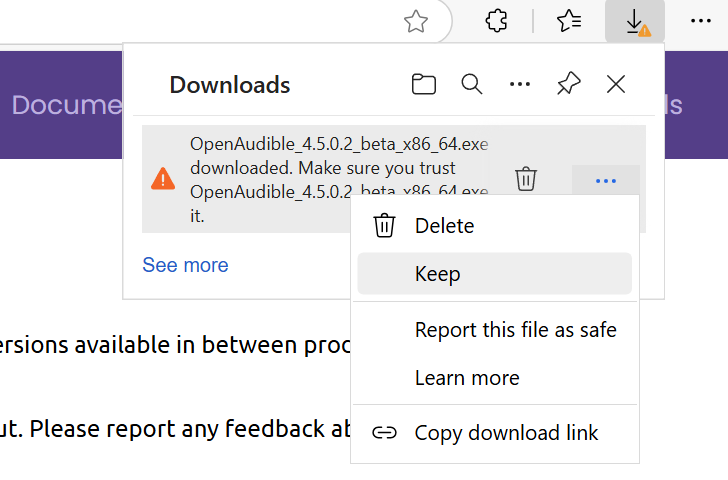
Launch the installer. Follow the prompts for installing. OpenAudible will be available in the Start menu.
macOS Installation
Download the OpenAudible DMG file and double click it. A window will show the OpenAudible application. Drag and drop it into the Applications directory.
Launch OpenAudible by double-clicking the application.
If your Mac is set to only allow apps from the Apple App Store to run, you may need to change your GateKeeper settings.
The first time you launch OpenAudible you may need to right-click the application and select "Open".
Linux Installation
Select one of the methods below. The first option is recommended for most Linux installations.
curl -OL https://openaudible.org/latest/linux_x86_64
chmod +x OpenAudible_x86_64.sh
./OpenAudible_x86_64.sh
Download the OpenAudible_x86_64.sh file. From the command line, and double click it. A window will show the OpenAudible application. Drag and drop it into the Applications directory.
Launch OpenAudible by double-clicking the application. The first time you launch OpenAudible you may need to right-click the application and select "Open".
Portable (Universal) Installation
The OpenAudible_portable.zip download is a single folder that runs on Windows, macOS, and Linux (Intel/AMD and ARM64) without an installer. It keeps your library and settings in a data folder next to the app, so it can run from a thumb drive. The portable version is recommended for advanced users — most people should use the regular installer for their platform, which bundles everything it needs.
- Install a Java runtime (JRE or JDK), version 17 or newer, such as Eclipse Temurin. Check it is on your PATH by running
java -versionin a terminal. - Download OpenAudible_portable.zip and unzip it to a writable folder. Do not run it from inside the zip file or from read-only media.
- Run the launcher script in the
OpenAudiblefolder:- Windows: double-click
openaudible.bat - macOS and Linux: open a terminal in the folder and run
./openaudible.sh
- Windows: double-click
curl -L -o OpenAudible_portable.zip https://openaudible.org/latest/portable
unzip OpenAudible_portable.zip
cd OpenAudible
./openaudible.sh
If you see "Permission denied" on macOS or Linux, your unzip tool dropped the file permissions. Restore them with chmod +x openaudible.sh bin/mac/ffmpeg bin/linux_*/ffmpeg.
On macOS, Gatekeeper may block files extracted from a downloaded zip. From inside the folder, run xattr -dr com.apple.quarantine . to clear the quarantine flag.
On Linux, the portable version also needs WebKitGTK for the login window — see the WebKit packages below.
Install from Command Line
OpenAudible can be installed from the command line. The installer can be run with the -q argument to install quietly in the standard location. This can be helpful for the vision impaired.
Note: The latest version information with SHA checksums is available as json.
macOS
OpenAudible is available via Homebrew. Run the following command in a terminal window:
brew install --cask openaudibleWindows
Chocolatey is a great way to install Windows programs.
choco install openaudibleYou can download and install OpenAudible from the Windows command line:
The optional -q quiet flag skips the installation GUI and installs in the default location. You will still be asked by User Account Control to approve the installation.
curl -# -OL https://openaudible.org/latest/win_x86_64

OpenAudible_win.exe -q
Linux
Several installer options are available for Linux users. The installer script is recommended.
curl -L -s https://openaudible.org/latest/linux_x86_64 | sh -s -- -qcurl -OL https://openaudible.org/latest/linux_AppImage && chmod +x OpenAudible_x86_64.AppImagecurl -OL https://openaudible.org/latest/linux_x86_64_deb && sudo dpkg -i OpenAudible_x86_64.deb && sudo apt-get install -fcurl -OL https://openaudible.org/latest/linux_x86_64_rpm && sudo dnf install OpenAudible_x86_64.rpm
Webkit is a required dependency for the built-in web browser used for logging in. You may need to install libwebkit2gtk-4.1-0 or webkit2gtk4.1 depending on your system.
For Debian/Ubuntu (apt): sudo apt install libwebkit2gtk-4.1-0
For Fedora (dnf): sudo dnf install webkit2gtk4.1 webkit2gtk4.1-devel
For RHEL/CentOS (yum): sudo yum install webkit2gtk4.1 webkit2gtk4.1-devel
For openSUSE (zypper): sudo zypper install webkit2gtk4.1 webkit2gtk4.1-devel libgthread-2_0_0
For Arch Linux (pacman): sudo pacman -S webkit2gtk
Code Signatures and Checksums
Always download OpenAudible from our website. The Windows and Mac versions are digitally signed.
Version information and SHA checksums are in this swt_version.json.
Upgrading OpenAudible
A check for new versions is performed automatically in OpenAudible, enabled/disabled in the preferences. To manually check for a new version, use the About menu: Check for Update.
If you get a message that an upgrade is available, you can usually click on the notice to go to a page with upgrade instructions.
For Windows users, download the latest OpenAudible_win.exe installer and run.
For Mac, download and open the OpenAudible.dmg and drag and drop OpenAudible into the Applications directory.
For Linux, if you use the recommended installer, download and run OpenAudible_x86_64.sh to install it in the same location.
If you used the .rpm or .deb package, use the same commands above to install over your existing version.
You can also uninstall the application using the instructions below and then follow the installation instructions above.
Uninstalling OpenAudible
Uninstalling OpenAudible uses industry standards.
For Mac and AppImage users, delete the application file by dragging it to the trash.
If you used the installer, there will be an uninstaller application in the OpenAudible directory.
Windows users can also use the "Add or Remove Programs" from the Start menu.
The OpenAudible application metadata directory can be thrown away too, but only if you want to get rid of your user settings and backed up audiobook media.